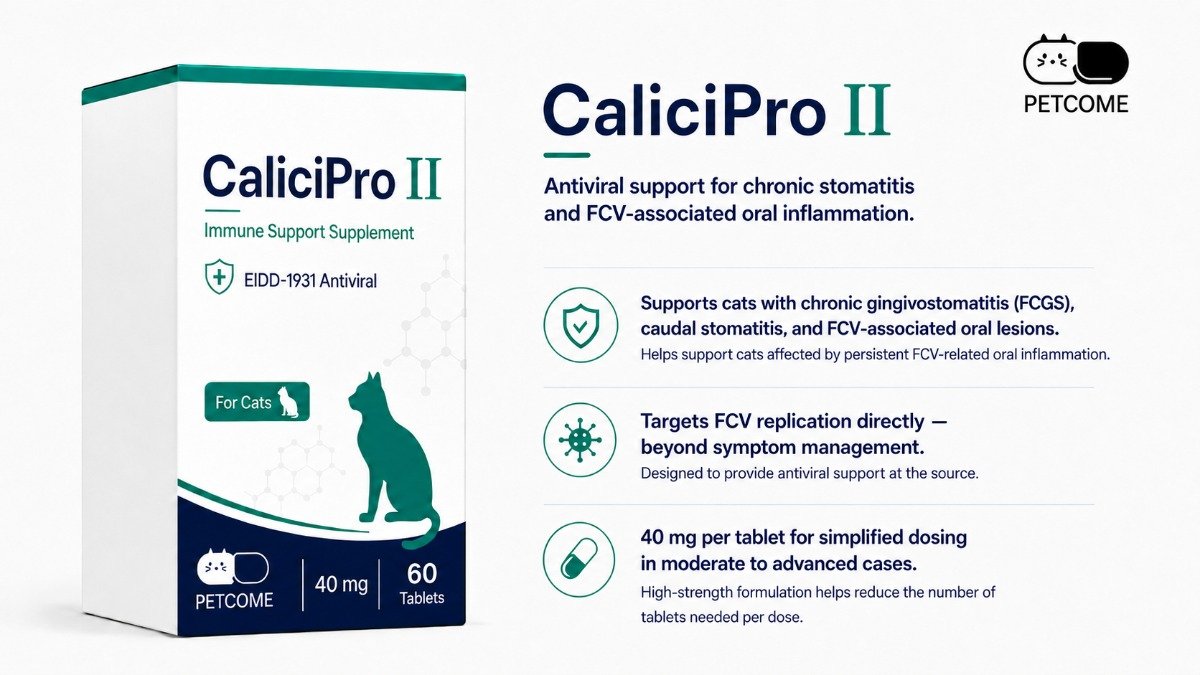
01 / Product profile
One ingredient. Two tablet strengths.
Select according to the individual prescription and ease of administration, not an assumption that a higher tablet strength means greater efficacy. [1]
| Specification | CaliciPro I | CaliciPro II |
|---|---|---|
| Labelled ingredient | EIDD-1931 (NHC) | EIDD-1931 (NHC) |
| Per tablet | 20 mg | 40 mg |
| Base pack | 60 tablets / box | 60 tablets / box |
| Total tablet options | 60 / 120 / 180 | 60 / 120 / 180 |
| Website selection guide | Cats below 2 kg | Cats at or above 2 kg |
| Planning consideration | Lower tablet strength for assessing smaller individual doses | Higher tablet strength for assessing the number of tablets needed |
EIDD-1931 ≠ molnupiravir
EIDD-1931 is N4-hydroxycytidine (NHC); molnupiravir (EIDD-2801) is its prodrug. Studies of different compounds or formulations cannot directly establish CaliciPro efficacy, oral exposure or milligram-for-milligram conversion. [1] [4]
02 / Clinical rationale
Look beyond lesions to persistent stimulation.
FCV and persistent oral antigens
Virus-related stimulation may contribute to disease initiation and persistence.
Immune activation and mucosal injury
Ongoing antigen exposure and host responses jointly influence lesions.
Periodontal antigens and microbial amplification
Plaque, periodontal disease and barrier disruption may intensify inflammation.
Persistent chronic inflammation
Assess viral factors, the oral environment and immune regulation together.
FCGS exhibits exhaustion-like CD8⁺ T-cell and mitochondrial transcriptomic signals. These are not direct proof of functional exhaustion or FCV as the sole cause. [3]
Antiviral assessment must retain dental care, pain control, nutrition and management of comorbidities. [1] [7]
03 / Evidence overview
What does the evidence support?
2021 · FCV–FCGS association
Fried et al. detected FCV in 21 of 23 FCGS cats and none of 19 controls. This supports an infection-related association, not proof that FCV causes every case; it was not a product trial. [2]
2025 · Pilot antiviral intervention
An ACVIM abstract reported lesion improvement in 4/5 and reduced shedding in 2/5 FCV-positive cats with persistent post-extraction FCGS treated with molnupiravir; untreated controls had 0/3 for both outcomes. This was an eight-cat, four-week conference abstract, not a CaliciPro trial. [4]
2026 · Observational combination treatment
Katayama et al. reported improved clinical signs and some biomarkers in 52 cases after antibacterial and antiviral combination therapy. There was no randomized control; early treatment included moxifloxacin. Individual drug effects cannot be separated, and this was not a CaliciPro-specific study. [5]
04 / Case assessment
Establish a baseline you can follow.
Oral diagnosis and dental imaging
Document caudal, gingival, buccal and lingual lesions. Assess periodontal disease, retained roots and tooth resorption. Consider sampling and histopathology for atypical, unilateral or mass-like lesions.
Comorbidities, history and risk
Record weight, appetite, pain, previous extractions and all medicines or supplements. Assess FeLV/FIV, hepatic and renal function and other infections as indicated; obtain baseline CBC and biochemistry.
FCV testing and interpretation
A single negative does not fully exclude infection; a positive does not prove FCV is solely responsible for the lesions. Consider sampling, assay and clinical concern when deciding whether to retest. [2] [6] [7]
Shared decisions and endpoints
Agree on observation criteria, review dates and how to manage abnormalities. Explain evidence limitations and local requirements. Neither a single PCR value nor subjective appetite improvement replaces a full assessment. [1] [7]
05 / Supply planning
Establish the prescription, then calculate tablets.
A purchasing period is not a validated treatment duration. [1]
Calculation relationships · no preset dose
Tablets per dose = weight in kg × prescribed mg/kg/dose ÷ mg per tablet
Tablets per day = tablets per dose × doses per day
Boxes needed = round up (tablets per day × days ÷ 60)
Mathematical example: a prescription totalling 3 tablets daily
| Period | Tablet total | 60 tablets / box |
|---|---|---|
| Days per box | 60 ÷ 3 | 20 days |
| 12 weeks (84 days) | 252 | 5 boxes (300 tablets) |
| 20 weeks (140 days) | 420 | 7 boxes (420 tablets) |
120 / 180 tablets correspond to totals of 2 / 3 boxes and do not change the daily prescription. CaliciPro I / II contain different amounts per tablet: recalculate when switching, do not retain the same tablet count, and do not substitute milligram-for-milligram with molnupiravir.
06 / Monitoring & safety
Assess benefit and risk through follow-up.
Adapted from PETCOME veterinary resources; review frequency must reflect individual risk. [1]
- Before starting: CBC, biochemistry, weight, appetite, pain and oral photographs from consistent angles.
- Home records: administration, vomiting/diarrhoea, food intake, drooling, activity and regular weight checks.
- Approximately every 4 weeks: clinical and oral review, CBC and biochemistry; earlier for high-risk cases or abnormalities.
- Before stopping or adjusting: compare lesions, pain, weight and laboratory trends, not just elapsed days.
Combinations and special populations
Use additional caution in pregnancy, lactation, breeding animals, juveniles, hepatic or renal disease and cytopenias. Comprehensive product-specific safety and interaction data are lacking; universal safety cannot be claimed.
No single medicine replaces comprehensive care
Retain dental treatment, analgesia and nutritional support. Antimicrobials require an indication and a stop/review plan. Long-term antibiotics or supplements are not mandatory for every case. The attending veterinarian reviews all concurrent medicines. [1] [7]
For inadequate response or relapse, reassess dental lesions, adherence, re-exposure and comorbidities rather than simply prolonging treatment or increasing doses independently.
07 / References & resources
Trace the evidence. Continue reading.
Sources open in a new tab to preserve your reading position.
- PETCOME · Product information & veterinary resources ↗
- Fried WA et al. · Am J Vet Res. 2021;82:381–394 ↗
- Soltero-Rivera M et al. · Scientific Reports (2026) ↗
- Alvarado Colon JC · ACVIM Forum 2025 · ID26 ↗
- Katayama M, Uemura Y · Vet Sci. 2026;13:363 ↗
- Druet I, Hennet P · Front Vet Sci. 2017;4:209 ↗
- ABCD · Guideline for feline calicivirus infection ↗